


A Linear Historical Timeline. This article explores The Star of Jacob Prophecy and its historical significance.
From Balaam’s oracle to the headlines on your screen
Hazan Gavriel ben David · Amarillo, Texas · Elul 5786 / September 2026
I first published this material months ago. It sat on the site with one view. That is on me. The teaching was buried in chapters, asides, and personal scenery that did not help a reader walk the road. This post is the rewrite: one line through time. The Torah first. Then the Zohar. After that, the dates. Then the headlines as they appeared.
No decoration. There is no Christian overlay. No private setting. Only what the Tanakh says, what the Zohar says, what Rabbi Ephraim Palvanov has been teaching in public, and what the newspapers printed on the day the thing happened.

My teachers in this matter are Rabbi Tovia Singer, Rabbi Ephraim Palvanov, Rabbi Mendel Kessin, Rabbi Zev Leff, and others across the Jewish world who have said, in their own language, that we are no longer speaking about a distant acharit hayamim. We are watching it.
Rabbi Singer has said the prophecies are unfolding now, in real time, in the headlines. Rabbi Palvanov has spent years mapping Balaam’s star onto the Zohar’s calendar and onto a comet the astronomers named before anyone in a beit midrash asked for it.
Rabbi Kessin has been saying for years that the last war of Persia and the pride of Edom sit inside the same window. Rabbi Leff has said he hears the footsteps.
I am not a prophet. I am a chazzan in Amarillo who learned to read the Zohar with Palvanov’s classes and the Tanakh in the other.
What follows is the sequence.
I. The Oracle Itself
The oldest messianic line in the Torah does not come from a son of Jacob. It comes from Balaam, son of Beor, hired by Balak to curse Israel, who opened his mouth and could not curse them. In Parashat Balak, he says he is looking to the end of days — acharit hayamim — one of the few times the Chumash uses that phrase.
I see him, but not now; I behold him, but he is not near. A star has gone forth from Jacob, and a scepter has risen from Israel; it shall smash the brow of Moab and tear down all the children of Sheth. Edom shall be a possession, Seir a possession of his enemies; and Israel shall do valiantly.
— Numbers 24:17–18
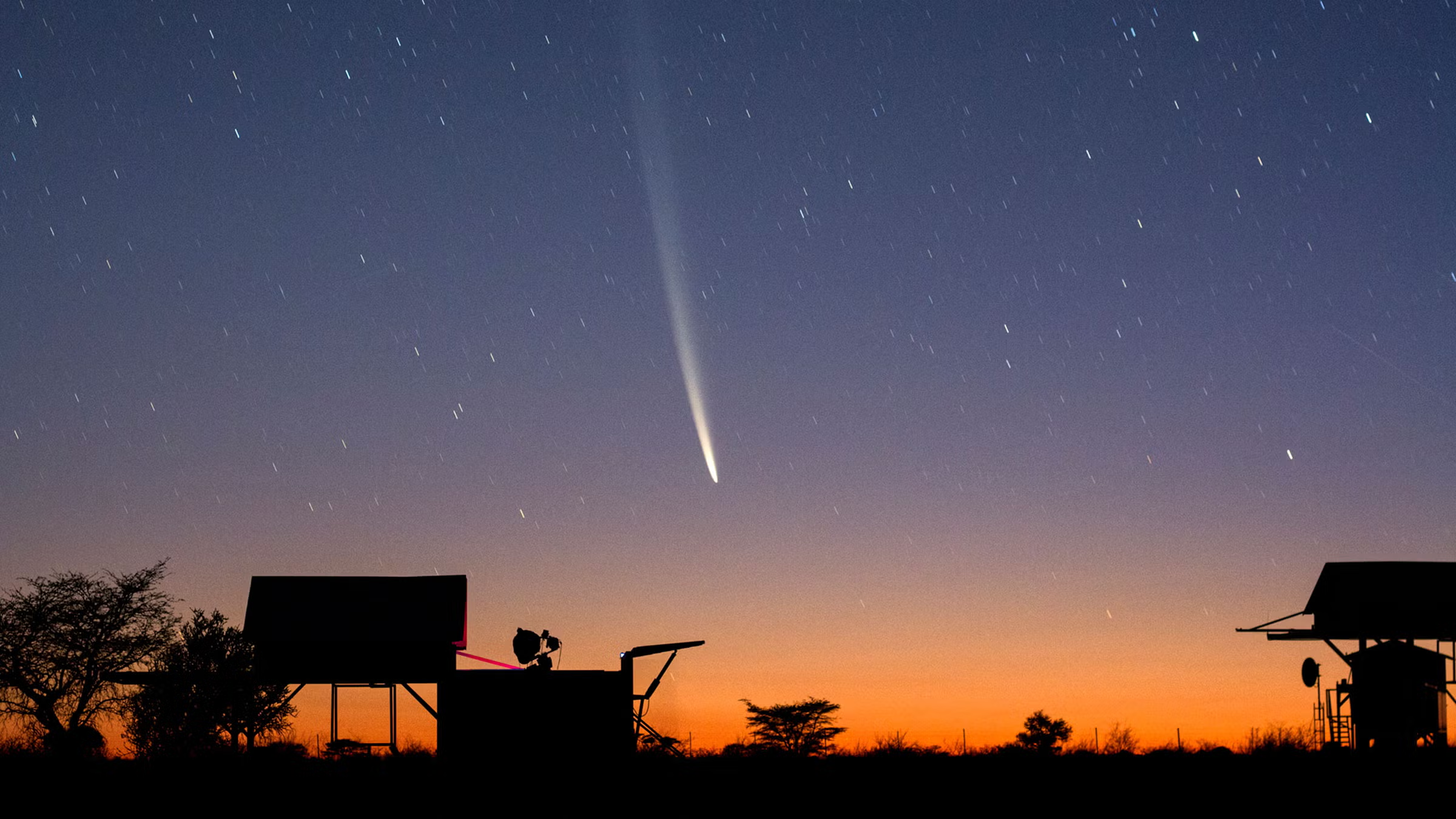
The Hebrew is darach kochav miYaakov. Darach is a path, a trail. Kochav is a light in the night sky. The combination is not a still lamp. It is a body that moves and leaves a wake. That is why Jewish readers for generations have heard a comet in the verse, not only a metaphor for a king. The scepter that rises with it is the staff of Israel. Moab is on the east bank. Edom is the west. The oracle is not a Christmas pageant. It is a map of the last war and the last king.
The Rambam cites this verse as one of the proofs that Mashiach will come. The Ramban reads the star as the gathering of the dispersed, a light crossing the firmament from the ends of heaven. Rabbi Akiva applied the verse in his generation to Shimon bar Kokhba and called him Bar Kokhba, Son of the Star. The revolt failed. The verse did not retire. It waited.
II. What the Zohar Added — The Calendar Inside the Star
The Zohar on Parashat Balak, volume III, 212b, does not leave the star as poetry. It gives a weekday, a Hebrew date, a duration, a first city, a collapse of buildings, the death of a ruler, a spread of the light across the world, wars in four directions, the loss of faith among the nations, the rise of a proud king, and then — when the star is gathered in — a trembling in the Land, a cave, a fire, a branch that rules, and the revealing of Mashiach.
It is taught that in the future the Holy One, blessed be He, will rebuild Jerusalem and reveal one firm star, glowing with seventy pillars of fire, and with seventy sparks flashing from it in the middle of the firmament, and they will be reigned over by seventy other stars, and they will glow and burn for seventy days.
— Zohar III, Balak 212b
And the star will be seen on the sixth day, on the twenty-fifth day of the sixth month. It will be gathered on the seventh day, at the end of seventy days. On the first day, it will be seen in Rome. On that same day, three high structures of that city of Rome will fall, and a great edifice will fall. The ruler of that city will die. Then the star will spread out to be seen in the rest of the world. In that time, great wars will stir all around the four corners of the world, and no faith will be found among its people.
— Zohar III, Balak 212b
In the middle of the world, when that star shines in the middle of the firmament, a great king will arise and rule the world, and his spirit will gain pride over all the kings, and he will awaken a war between the two sides, and he will become strong against them.
— Zohar III, Balak 212b
On the day that the star will be hidden, the Holy Land will tremble forty-five miles around the place of the Holy Temple, revealing an underground cave. From this cave will come out a blazing fire… and a great branch will grow out, and it will rule over the whole world… Then Mashiach will be revealed to the entire world.
— Zohar III, Balak 212b
The sixth month is Elul. The sixth day is Friday. The twenty-fifth of Elul is the day the Sages assign to the first day of Creation. The Zohar is saying: the sign that Jerusalem is about to be rebuilt in truth will rise on the anniversary of the world’s first dawn, on the eve of Shabbat, and it will burn for about seventy days.
Rome, in this literature, is not only the city on the Tiber. Rome is Edom — the power that sits at the center of the West in a given generation. Palvanov has also noted that in the lifetime of Rabbi Shimon bar Yochai, Beirut served as a Roman administrative capital in the East. When the Zohar says “a city of Rome,” a reader who knows the second century does not have to fly to Italy to find the buildings.

III. The Teachers Who Said: Look Up
Rabbi Ephraim Palvanov, writing at Mayim Achronim and teaching in Toronto, is the one who put the calendar on the public table. In December 2023, he taught that astronomers had found a new comet, C/2023 A3 Tsuchinshan–ATLAS, discovered 9 January 2023, predicted to reach perihelion — closest approach to the sun — on Friday, 27 September 2024. That civil date was 25 Elul 5784. A Friday. He said he was not a prophet. He was reading the Zohar next to an astronomy bulletin.
We know that one of the oldest prophecies and traditions about the Moshiach likely comes from Balaam, a Gentile prophet who came to curse Israel but couldn’t. Instead, he gives a prophecy that actually says, ‘I will tell you what will happen at the end of days.’
— Rabbi Ephraim Palvanov, cited in Israel365 News, 29 January 2024 and 28 August 2024
Israel365 News printed the claim twice before the comet arrived: first in January 2024 under the headline “EXPERT: Star of Jacob will appear on Friday, September 27,” and again in August 2024 under “Scientists expect Star of Jacob to appear this month.” Palvanov added the disclaimer then, and he has kept it: there are ways to read the passage. He still looked at the sky.
Rabbi Tovia Singer has not built a comet calendar. He has done something plainer. He has stood in front of cameras and said that the wars the Prophets named are no longer commentary. They are the news.
There are messianic prophecies unfolding now.
— Rabbi Tovia Singer, 2026 interview on missionaries and the signs of the age
What’s going on to the north? It’s in Ezekiel 38 and 39. Well, it’s happening right now as we are speaking, in real time. Israel is battling Iran’s proxies, Hezbollah, in the north. Those are headlines. Like, we don’t have to guess.
— Rabbi Tovia Singer, “The Signs of Messiah’s Arrival,” June 2026
Rabbi Mendel Kessin has taught for years from the Ramchal that the cosmic week is winding down, that Persia’s war and Edom’s pride sit inside the last window, and that the year 5786 carried the gematria of yavo Mashiach. After the nations moved to recognize a Palestinian state at the United Nations in September 2025, he called the vote itself a messianic event: the world lining up as Gog.
The United Nations is Gog and Magog. The UN represents the world, and therefore it must defy Israel. That is a messianic event. It means the Messiah is here.

— Rabbi Mendel Kessin, September 2025, reported by Israel Today
Rabbi Zev Leff asked whether Mashiach is here and answered in the old language that still fits: if you ask me if he is here, he is not here; if you ask me if I hear his footsteps, I hear his footsteps. He pointed to the ingathering, the land giving fruit, and the nations gathering against Israel as the shape of Gog and Magog.
These men do not agree on every date. They do not need to. They agree on the direction of the river.
IV. The Long Fuse — Before the Comet
1989 / 5750 — The Zohar’s last “late” gate
Palvanov has taught the Zohar’s calculation that the end of days begins a cosmic six hours before the Sabbath of history. Six hours is a quarter of a day. A heavenly day is a thousand years. A quarter is 250 years. Count back 250 years from the year 6000, and you land at 5750 — 1989–90. That year, the Berlin Wall fell. The Soviet Union cracked. A million Jews began to come home from the north. Palvanov’s own family was in that wave. The Talmud already said that the greatest sign of redemption is the Land bearing fruit again. By 1989, that sign was no longer a hope. It was an export.
9 January 2023 — The astronomers name the star
9 JANUARY 2023
A new comet is logged: C/2023 A3 (Tsuchinshan–ATLAS).
Astronomy circulars; later cited by Palvanov in his December 2023 class “Will Mashiach Come This Year?”
No rabbi commissioned the discovery. Purple Mountain Observatory in China and the ATLAS survey in South Africa found a dirty snowball on a long loop from the Oort Cloud. The predicted perihelion was 27 September 2024. Palvanov opened a Hebrew calendar, saw 25 Elul on a Friday, and remembered Balak 212b.

7 October 2023 / 22 Tishrei 5784 — Simchat Torah
7 OCTOBER 2023
Hamas-led militants burst from Gaza on Simchat Torah. More than 1,200 were murdered in Israel. Hostages taken into the tunnels.
Every paper on earth.
This is not the star. This is the war the star would later illuminate. The Zohar said that when the star appears, wars will already be stirring in the four corners. By the autumn of 2023, Israel was fighting in Gaza, under fire from Lebanon, watching Yemen close the Red Sea, and listening to Iran speak in the voice of Persia. Rabbi Singer would later say, ” We do not have to guess. The north is Ezekiel. The headlines are the north.
Isaiah 17 had waited longer than any city on earth. “Behold, Damascus will cease to be a city, and will become a ruinous heap.” Damascus had been conquered and rebuilt for three thousand years. The verse was still standing. So was the palace.

13 April 2024 — Persia fires in the open
13 APRIL 2024
Iran launches a direct missile-and-drone attack on Israel — the first time in history Tehran strikes the Jewish state in its own name, not only by proxy.
International wires, 13–14 April 2024
Singer has marked that date. For decades, Iran worked through other men’s hands. On 13 April, the mask came off. The midrash that Kessin teaches — Persia moving against the world, Edom answering — stopped being a page in Yalkut Shimoni and became a ticker.
31 July 2024 — Haniyeh in Tehran
31 JULY 2024
Ismail Haniyeh, political chief of Hamas, is killed in Tehran hours after Iran’s new president is sworn in.
Reuters / AP, 31 July–1 August 2024
The head of the October 7 political house dies in the capital of Persia. The scepter of Numbers 24 is not a metaphor when the men who planned the massacre start falling in other people’s bedrooms.
V. The Seventy Days
Friday, 27 September 2024 — 25 Elul 5784
27 SEPTEMBER 2024
Comet C/2023 A3 Tsuchinshan–ATLAS reaches perihelion. Astronomers call it visible. Photographers catch it in twilight. Palvanov later says he saw it from his own backyard.
NASA Earth Observatory; Sky & Telescope; BBC Sky at Night; Palvanov, “Lebanon & Iran in the End of Days,” 9 October 2024, and “The Mashiach Window,” 2025
The same civil night, while the comet was at the sun, Israeli aircraft put bunker-busters into Hezbollah’s underground headquarters in Dahiyeh, south Beirut. Multiple apartment blocks came down. A mushroom cloud stood over the suburb. The next day, the IDF and then Hezbollah itself said Hassan Nasrallah was dead.

27–28 SEPTEMBER 2024
“Hassan Nasrallah, Who Led Hezbollah for Decades, Killed at 64.” “Israel kills Hezbollah leader Hassan Nasrallah in airstrike.”
The New York Times, 28 September 2024; Reuters, 28 September 2024; AP, 28 September 2024
Hassan Nasrallah, who led the militant Hezbollah organization in Lebanon for more than three decades, was killed on Friday in heavy Israeli airstrikes just south of Beirut.
— The New York Times, 28 September 2024
The Israeli military said it carried out a precise airstrike on Friday while Hezbollah leaders were meeting at their headquarters… The strike leveled six apartment buildings.
— Al Jazeera, 28 September 2024
Read the Zohar again with those two sentences in your hand. A star seen on Friday, 25 Elul. On that same day, three high structures fall, a great edifice falls, and the ruler of that city dies. Palvanov’s reading: Beirut was Rome-in-the-East when the Zohar’s teaching was born. Nasrallah was the ruler of that fortress-city. The buildings were not a parable. They were dust on Saturday morning television.
Amos had already named the fire: “I will send fire upon the house of Hazael, and it shall devour the palaces of Ben-Hadad. I will break the bar of Damascus.” (Amos 1:4–5) Palvanov tied the bunker-busters to that fire. The comet was the clock. The fire was the headline.
The comet remains in the sky
The Zohar said seventy days. Perihelion was on 27 September. The closest approach to Earth was on 12 October 2024, during the Days of Awe into Sukkot of 5785. Naked-eye photographs filled the astronomy pages through October and into November. Palvanov counted the window to about 6 December 2024, when the object faded from ordinary sight. That is not midrash. That is an ephemeris.
16–17 October 2024 — Sinwar
16–17 OCTOBER 2024
Israeli troops kill Yahya Sinwar, Hamas leader and architect of October 7, in a ruined house in Rafah. A drone films a wounded man throwing a stick at the camera. Netanyahu calls it a milestone in “the sunset of Hamas’s evil reign.”
IDF statement, 17 October 2024; The New York Times, 18 October 2024; CNN, 17 October 2024
Haniyeh in July. Nasrallah on the day of the star. Sinwar three weeks later. The brow of Moab, in Balaam’s speech, is the leadership of the east bank of hatred. The children of Sheth are the wider swarm. The verse does not say Israel will argue with them. It says the scepter will smash.
5 November 2024 — A proud king in the middle of the world
5–6 NOVEMBER 2024
Donald J. Trump is elected the 47th President of the United States, to take office on 20 January 2025.
Every American paper.
The Zohar said that while the star shines in the middle of the firmament, a great king will arise, his spirit high over the other kings, and he will awaken war on two sides and prevail. Palvanov and Kessin have both, in different keys, cast this figure as a tool — a Cyrus, not a redeemer. Isaiah 45 calls Cyrus “My anointed” and still leaves him a Persian. The Jewish reading does not require the man to be righteous. It needs him to be useful. I will not baptize a president. I will also not pretend the Zohar’s “proud king in the middle of the world” landed in a vacuum.

6–8 December 2024 — The star is gathered; Damascus falls
8 DECEMBER 2024
“Syrian rebels topple Assad, who flees to Russia in Middle East shakeup.” “Damascus has been liberated, and the tyrant Bashar al-Assad has been overthrown.” Rebels enter the capital unopposed after a two-week lightning offensive. The family that ruled Syria for fifty years is gone in a night.
Reuters, 8 December 2024; CNN, 8 December 2024; The New York Times, 21 December 2024
Syrian rebels seized the capital, Damascus, unopposed on Sunday after a lightning advance that sent President Bashar al-Assad fleeing to Russia after a 13-year civil war and six decades of his family’s autocratic rule.
— Reuters, 8 December 2024
Israel bombs Damascus as 50-year peace deal ends with Assad’s overthrow: ‘Direct result of our forceful actions.’
— New York Post headline, 8 December 2024
Count it. 27 September to 6 December is seventy days. Assad fled in the night of 7–8 December. Palvanov taught “Damascus in the End of Days” on 10 December 2024, two days after the palace gates stood open. He read the Zohar’s “earthquake in the Holy Land” as a political quake first: the old order of Ishmael in Syria collapsing in the same week the star went dark.
Isaiah 17:1 is not finished. Damascus still has streets and minarets. The prophecy says the city will cease to be a city and become a ruinous heap. What fell in December 2024 was the kingdom of Damascus — “the fortress will disappear from Ephraim, and the kingdom from Damascus” (Isaiah 17:3). The throne of Ben-Hadad was empty. The portraits came off the walls. A year later reporters walked Umayyad Square and wrote that the sign “Assad’s Syria welcomes you” was gone. That is not the last word of Isaiah 17. It is the first word that verse has been able to speak in three millennia.
Zechariah 9 ties Damascus to the resting of the word of Hashem at the threshold of the last king. Palvanov spent a class on that knot: why would the Presence brush Damascus at all? Because the north has to break before Zion is quiet.
VI. After the Star — 2025 and 5786
The Zohar does not say Mashiach stands up on day seventy-one. It says the star is gathered, the Land trembles, wars continue in four directions, faith thins out among the nations, and then — in a time it does not date to the hour — a branch rules and Mashiach is revealed to the whole world. The years after the comet have been that middle.
The four fronts
By the end of 2024, Israel had fought in Gaza, Lebanon, Yemen’s approaches, and the Syrian space that Iran had used as a corridor. Palvanov said the Zohar’s “four sides” were no longer a homily. Hezbollah’s arsenal was broken in the weeks after Nasrallah. The Houthis kept firing and kept getting hit. In August 2025, Israeli strikes killed the Houthi prime minister in Yemen. The papers treated it as another raid. The sequence treated it as another name on Ishmael’s roster.

September 2025 — The nations vote
SEPTEMBER 2025
Western governments and a United Nations majority move to recognize a Palestinian state on the eve of Rosh Hashanah 5786.
UN coverage; Rabbi Kessin’s recorded response, 19–22 September 2025; Israel Today, 29 September 2025
Kessin called the UN “Gog and Magog” because Gog is not only a man from the north. Gog is the world assembled against Zion. Zechariah 14 and Ezekiel 38 do not require every rifle to be Russian. They require the nations to decide that Jerusalem is theirs to carve.
5786 — “The Messiah will come”
Kessin taught that 786, the number of the year 5786, equals yavo Mashiach — “the Messiah will come” — and also the language of the revelation at Sinai. He read the Yalkut Shimoni on Persia’s last war and said: ” This is the last war; a heavenly voice says, ‘ Do not fear; your redemption has arrived. Whether a student accepts every gematria is not the point. The point is that a senior teacher of hashkafah stopped speaking in the future tense.
Palvanov’s July 2025 class, “The Mashiach Window,” given as his last biweekly at the Sephardic Kehila Center in Toronto, asked the question his students had started to ask: you have not talked about the star in a while — where are we? His recap was blunt. The comet came on the day. He saw it. An oppressor of Israel died. Buildings fell. Then the political earthquake. Then fires around Jerusalem in a later season that he was willing to read against the Zohar’s fire. “We’ve basically [seen] that whole passage. Everything has been fulfilled from the comet to the death of the oppressor to the buildings to the earthquakes to the fires.” He did not say the story was over. He said the opening acts were no longer theoretical.
2026 — Persia, Edom, and the year 5787
As these lines are written — 22 September 2026, the week after Rosh Hashanah 5787 — the war with Iran and its remaining arms is the air the Jewish world is breathing. Singer sat with interviewers and kept pointing at Ezekiel 38. Kessin kept pointing at Paras and Edom. Palvanov taught “Trump, Iran & the Year of the Horse” in February 2026 and “Are We Living in the End of Days?” in July 2026 and answered a student who asked the simple question: Are we in the end of days? “Absolutely. I believe we 100% are.”
Rosh Hashanah 5787 fell at sundown Friday, 11 September 2026 — twenty-five years to the day from the falling of the towers in New York, the other “Rome” some readers have always heard in the Zohar. I will not force 2001 into 25 Elul. The Zohar’s date in 2001 was not 11 September. Honesty is part of emunah. What I will say is this: Edom’s towers have already fallen once in our lifetime, and Edom’s pride is again the weather of the world, and the shofar of 5787 sounded on a Friday night when the whole earth was already marked with ash. The Sages said the footsteps would not be quiet.
VII. What Has Not Happened Yet
A serious Jew does not pretend the scroll is finished because the first columns came true. The Zohar still awaits its full revelation. The Rambam still waits for a king from David who fights the wars of Hashem, builds the Temple in its place, and gathers the dispersed. Rabbi Leff repeated those three tests in 2026. They have not been checked off. Isaiah 17 still has a heap where a city stands. Ezekiel 38 still has a gathering of nations larger than a proxy war. Zechariah still has feet standing on the Mount of Olives. The Third Temple is not up. Mashiach is not revealed to the entire world.
That is not a reason to go back to sleep. It is a reason to stay awake without becoming a date-setter. Palvanov’s standing sentence is the right one: I am not a prophet. I am reading. Singer’s standing sentence is the other right one: it is happening now; we do not have to guess. Both can be true.
VIII. How to Read This Without Losing the Torah
Christians will try to steal Balaam’s star for Bethlehem. Rabbi Singer has been dismantling that theft for decades. Numbers 24:17 is about a king who smashes Moab and takes Edom. The man from Nazareth did not do that. The verse is still in our book.
Internet mystics will try to turn the comet into Nibiru, a second sun, a planet of fear. The Zohar does not need a second sun. It needed a kochav on a path, on a Friday, on the 25th of Elul, burning for about seventy days, with buildings and a ruler falling in a city of Rome as the light appeared. That is a narrower claim. Narrow claims are stronger.
Politicians will try to wear the star as a campaign pin. Cyrus was a tool. Pharaoh was a tool. The proud king in the Zohar is a tool. The scepter rises from Israel, not from Washington and not from Moscow.
The work that remains is the work that the Sages always named: teshuvah, unity, Torah, the mitzvot of the Land, and the refusal to bow to the seventy nations when they lose their faith. The Zohar said that when the star shines, faith will not be found among them. Look at a university quad, a UN gallery, a comment thread. Then open a Chumash.
IX. The Line, One More Time
Balaam saw a star out of Jacob and a scepter out of Israel, not now and not near.
The Zohar dated the star to Friday, the 25th of Elul, seventy days, Rome, three structures, a palace, a dead ruler, four-front war, a proud king, a trembling Land, a revealed Mashiach.
Astronomers, with no interest in Balak, set perihelion for Friday, 27 September 2024 — 25 Elul 5784.
That night, the comet reached the sun, and Nasrallah was buried under the buildings of Dahiyeh.
Seventy days later, the comet faded, and Assad’s Damascus ceased to be a kingdom.
In the same window, Haniyeh died in Tehran, Sinwar died in Rafah, a proud Western king returned to the middle of the world, the nations voted to carve Jerusalem, and Persia came out of hiding.
Singer says the prophecy is happening now. Palvanov says the opening passage has already walked onto the stage. Kessin says the last war is this war. Leff hears footsteps.
I am a Jew in Amarillo. No prophet’s staff. I have a Zohar, a Tanakh, a calendar, and a stack of newspapers. That is enough to say to anyone who still thinks this is a metaphor: the star was in the sky. The buildings fell. The ruler died. The city of the north lost its king. The rest of the page is still being written in front of your eyes.
May we have emunah in the days when the Exodus seems small. Help us not invent what the text does not say. May we not deny what the text and the day have already said together.
חזקחזקונתחזק
Learn with us at beithashoavah.org · Teachers: Rabbi Tovia Singer, Rabbi Ephraim Palvanov, and the living chain of Torah.
Sources for the reader
Tanakh: Numbers 24:17–19; Isaiah 17:1–3; Amos 1:3–5; Ezekiel 38–39; Zechariah 9 and 14; Isaiah 45:1–3.
Zohar III, Balak 212b (verses 501–503 and following), as translated in standard editions and as taught by Palvanov.
Rabbi Ephraim Palvanov: “Will Mashiach Come This Year?” (Dec 2023); Israel365 News interviews (29 Jan 2024; 28 Aug 2024); “Lebanon & Iran in the End of Days” (9 Oct 2024); “Damascus in the End of Days” (10 Dec 2024); “The Mashiach Window” (31 July / 1 Sept 2025); “Are We Living in the End of Days?” (July 2026).
Rabbi Tovia Singer: ongoing classes 2024–2026 on Ezekiel 38, the signs of Mashiach, and “prophecy happening right now.”
Rabbi Mendel Kessin: teachings on 5786, Persia and Edom, and the UN as Gog (Sept 2025; 2026 lectures reported by Israel365 News).
Rabbi Zev Leff: interviews on the footsteps of Mashiach and Gog and Magog (Hidabroot / Living Inspired, 2026).
Headlines as cited: New York Times, Reuters, AP, CNN, Al Jazeera, New York Post, NASA Earth Observatory, Sky & Telescope — dates given in the body.
This essay replaces earlier chapter drafts on beithashoavah.org. Those drafts mixed the timeline with private scenes that did not belong in the argument. The argument is the timeline.


